01 Overview
John Suh’s “Agent Platform of 2027” is the clearest map I’ve read of what an agent platform needs, from actors and sandboxes to listeners that agents build for themselves. Importantly, John gets the foundational plumbing right.
Near the end, he changes metaphors. The winning platform, he writes, will look less like a factory that builds factories and more like a garden: a base where each customer plants their own seeds, and agents, people, and business signals tend the plants that come up.
We named our company Infinite Garden, so I’m biased in agreeing with this sentiment.
Over the past 18 months, our team has been growing a version of that garden in one vertical: consumer brands. Our agents research demand, develop products, and launch brands as experiments. The market decides which brands get more room and which get pruned, and the lessons from each batch carry into the next.
Living in a comparably minded system, I agree with John on the plumbing. The beds and irrigation matter, and we’ve laid our own over the past year.
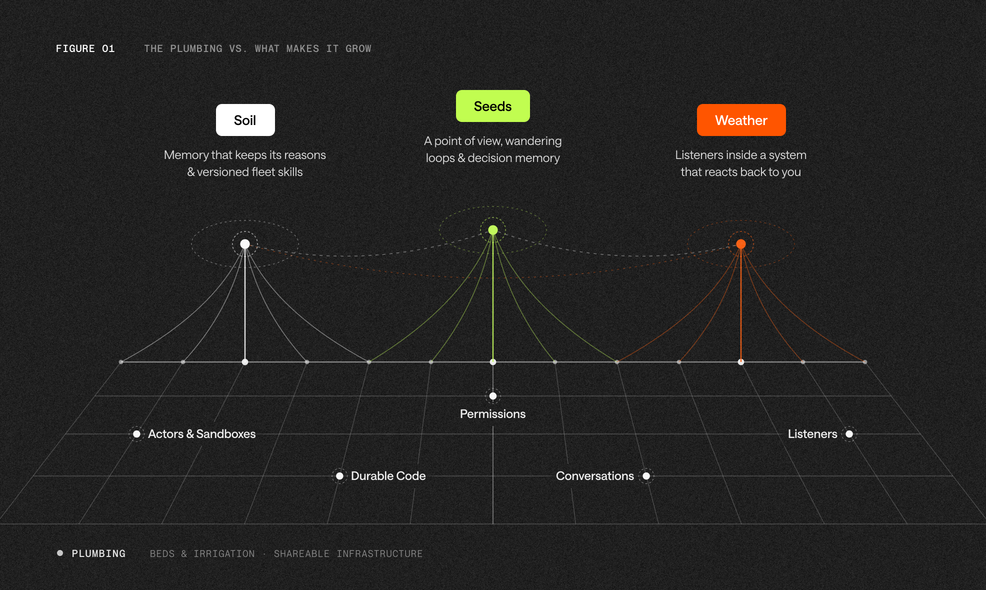
However, beds and irrigation don’t make a garden grow. The hard problems we keep hitting are, metaphorically, the soil, seeds, and weather. A platform should treat those three as first-class layers instead of leaving each customer to hack the layers together on top.
02 The Runtime Layer
John’s doc maps the runtime for an agent swarm: isolated actors, shared sandboxes, a permissioned filesystem, conversations split from sessions, an inbox for approvals, listeners, and workflows written as code.
Infinite Garden’s system runs on in-house versions of three of those pieces: session handling, durable workflows, and permissions. We built those three first because a swarm launching brands with no person watching has to get each run through four moments unattended: pausing for a human decision, waiting on another agent, hitting a bug, and reaching for a credential.
Conversations stay separate from sessions
When a run needs a person (a milestone, a change in direction, a blocker), the system posts a short note linking to the draft, test, or launch in question. Raw sessions stay in logs and traces. You open a session to debug a failed run, the way you’d open source code.
Workflows are durable code
A run can wait a minute or a week on another agent’s review, or a fix, without holding a live process or burning compute.
We’re pushing errors the same way: a run that hits a bug logs the incident, hands the incident to a coding harness, and picks the loop back up without pulling a person in.
Permissions live in code
Thus, a clever prompt can’t talk an agent past a budget limit. The model session runs isolated, with no credentials, and emits structured actions. Trusted code checks delegation, scope, and budget before a single action executes.
Together, session handling, durable workflows, and permissions see a swarm through waits, bugs, and handoffs to a person without an agent overstepping a budget, yet run 400 still starts out no wiser than run 1. Carrying lessons from one run to the next takes three more layers, starting with what the system remembers.
Figure 01 · Beyond the plumbingStandardized infrastructure builds the beds and irrigation. Soil, seeds, and weather are the living layers that make each garden compound over time.
03 The Soil: Scoped Memory
John’s shared filesystem, part GitHub and part Google Drive, records what each agent wrote and when, which solves storage. The harder problem sits one level up: deciding which of a swarm’s thousands of test results deserve to become shared skill, before one lucky result spreads across the fleet as a rule.
Companies usually botch institutional learning in one of two ways. Either they forget (a finding lives in one employee’s head and leaves when that employee does), or they over-learn: one ad beats the control and hardens overnight into “people want this message,” steering decisions in markets where the message was never tested.
In a noisy market, a single win is usually luck. A human team that treats a lucky hit as a rule makes bad calls slowly. A fleet of agents makes a dozen before lunch.
We have a rule at Infinite Garden: a test result is evidence, not a verdict. Source-backed knowledge, work records, each agent’s memory, and reusable skills live in four separate stores, so one agent’s experience never becomes shared truth.
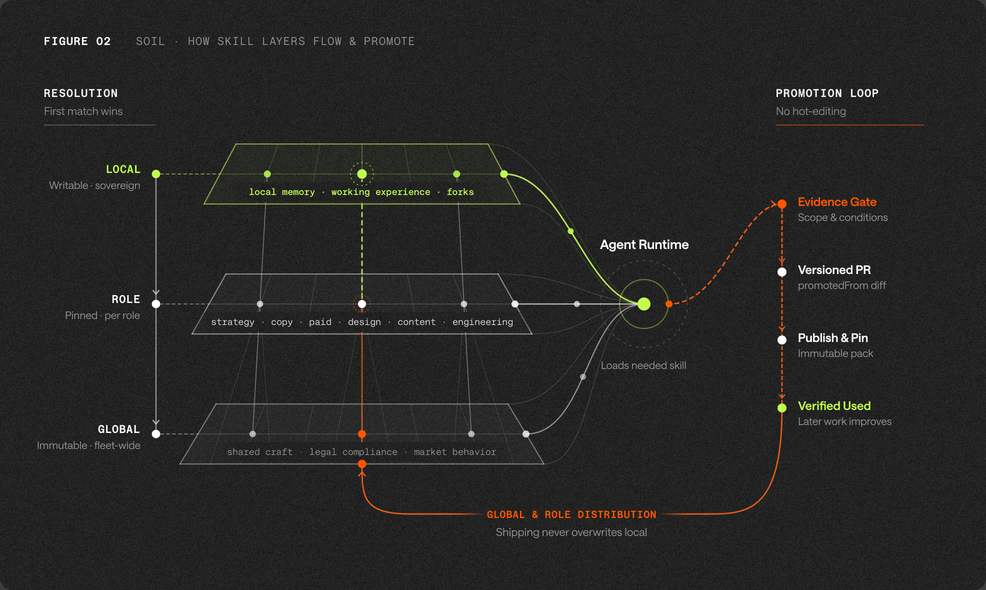
Skills resolve from the inside out: local, then role, then global. Shared craft and guardrails live in versioned packs behind a thin navigator, so an agent loads only what a task needs. Each agent keeps a local layer that central pushes never overwrite. An agent can fork a shared skill to experiment, with the source version stamped on the fork, but a fork can’t override protected rules or permissions.
When a focus supplement ad wins with college students the week before finals, the system files the win with the scope attached (college students, finals week, one ad test) rather than as a truth about focus supplements in general. That lesson reaches a 60-year-old worried about brain fog only after a small test with that audience shows the same message working there too.
When a local adaptation holds up across live briefs, a pull request promotes the adaptation into a shared pack, lineage attached. Then we check that later runs load the new skill and that output from those runs improves. Published and used are different states.
The same discipline runs in reverse. When a source changes, superseded evidence gets withdrawn, and the skills and memories built on that evidence get reviewed. Flat tests and pruned brands stay on file too.
Minoxidil was approved in 1979 for high blood pressure. Doctors bothered to record an odd side effect: patients growing hair, and nine years later the drug came back as Rogaine. Second acts happen only if old failures stay findable, with their reasons intact.
Version control tells you what changed. Memory has to tell you why a belief moved, which evidence backed the move, and which audience the belief covers. Scoped memory turns old runs into soil.
Figure 02 · How local learning becomes shared skillSkills resolve inside-out (Local → Role → Global) while proven local adaptations travel back up through curation, versioned PRs, and adoption verification.
04 The Seeds: Learned Priors
John is right that working systems favor narrow, code-defined agents over one mega-agent. That debate usually centers on tools and access. The question that gets less attention is what an agent looks at, and what it’s pushed to have an opinion about.
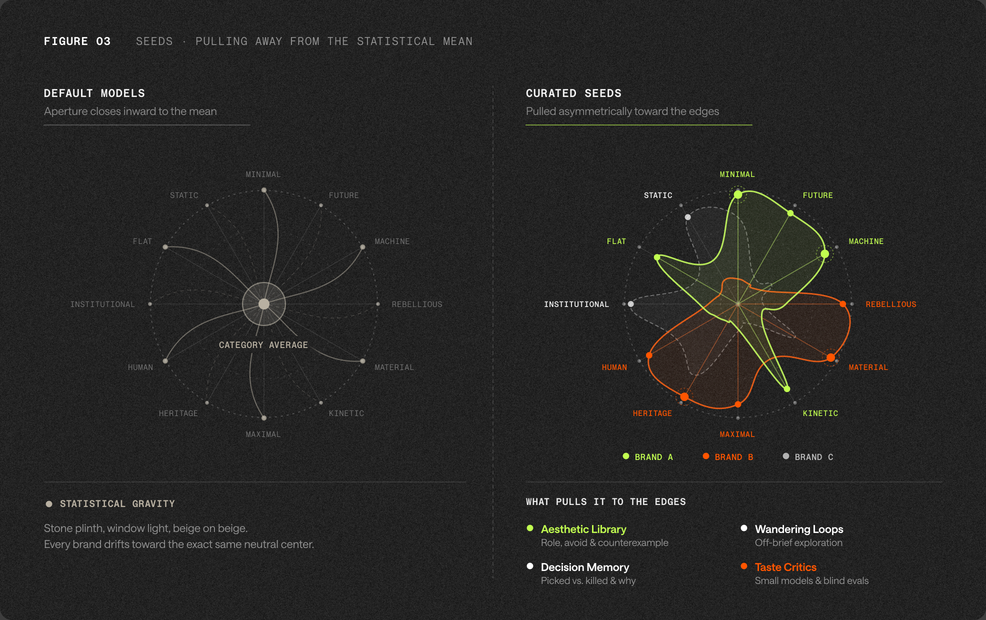
Left alone, models drift toward the average. Ask for a premium supplement ad, and you can picture the result before the first pixel renders: a bottle on a stone plinth, soft window light, a sprig of green, beige on beige.
The research backs up what designers using these tools have noticed. In a 2024 study, writers handed one idea from a language model wrote stories rated more creative, and 10.7% more similar to each other. In another, designers sketching with Midjourney stuck closer to an example they’d been shown than designers sketching unaided or with image search. Each piece gets sharper while the pool narrows.
Run a million agents on a handful of base models, and you get a monoculture. Brand after brand looks lifted from the same deck, and one blight can wipe out the field.
Clever prompting won’t break a monoculture. We’ve been building stranger mechanisms to give agents their own eyes.
The base is an aesthetic library searchable by what a reference does and how it looks. A film still might earn a spot for the pacing or the light. For each brief, the system pulls a short list and gives each image a strict job: which qualities to borrow, which to leave behind, and sometimes a counterexample to mark the edge. We pair references that would never share a board and ask the agent to explain the connection. If the agent can’t, the board is a pile of styles.
Agents also get time off the brief. In short, wandering loops shaped by creative personas, an agent browses with no task and logs the finds that stood out, with a reason for each. (The loops are expensive to run, a separate problem.)
Those notes can resurface weeks later in unrelated work, like a designer pulling from a museum visit or a street sign months later. Separate memory loops track creative decisions rather than finished outputs: what got picked, what got killed, and why. Without that history, an agent makes the same safe call again and again.
We’re testing small models trained to pick the stronger of two polished directions and explain why, and agents with clashing sensibilities that critique each other the way a good creative team argues.
Our own sense that the work looks sharper proves nothing. We’ve set up a blind, matched benchmark, with held-out briefs sealed in advance, to test whether the library makes outputs measurably more distinctive. We haven’t run the benchmark yet. Until we do, the lift is a hunch.
Put together, a seed carries more than a config file and a set of tools: a point of view, a history of choices kept and killed, and a memory inherited from earlier runs.
Figure 03 · Escaping the statistical averageUnsteered models collapse toward the category average. Aesthetic retrieval, wandering loops, decision memory, and taste critics push outputs into distinct territories.
05 The Weather: Reflexive Sensing
John’s listeners let agents subscribe to the world through webhooks, streams, and change data capture, turning events into signals. In a real business, though, the signals that matter most come from a market reacting to your own moves.
We went deeper on this in Demand is a complex system, but the short version is simple: engineers can bench-test each part of a jet engine, bolt the parts together, and trust the assembled engine to perform close to the numbers, because the parts don’t change their behavior once installed. Consumer demand works the other way: customers, competitors, culture, prices, and channels keep reacting to each other and to your launch, so a pre-launch test can’t show you the market your launch creates.
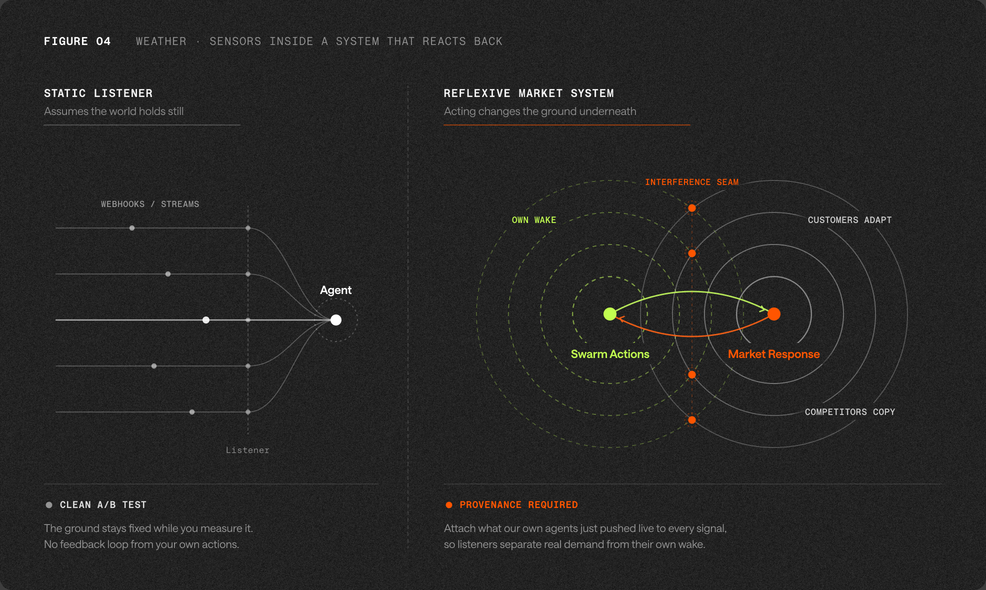
Once a swarm operates in a market, the swarm becomes part of that market. Customers learn, competitors copy, and last month’s winning ad stops winning. No moment repeats, so clean A/B tests are rare.
That changes what a listener has to carry. A monitor blind to the ad, price change, or launch our own agents just pushed live ends up chasing the swarm’s own wake. Each signal needs provenance attached, starting with our agents’ last moves. In practice, that means many small moves across a portfolio instead of one big bet, with expensive physical commitments held as late as the evidence allows.
Product-market fit keeps moving after launch. The weather keeps shifting, and the system has to keep reading the sky.
Figure 04 · Chasing your own wakeStatic listeners assume the world holds still. In a live market, swarm actions create wake ripples that collide with customer adaptation and competitor copies.
A human team that treats a lucky hit as a rule makes bad calls slowly. A fleet of agents makes a dozen before lunch.
06 What doesn’t become a database
John argues that most other software gets demoted to a database under the agent layer. For most SaaS (CRMs, ticketing tools, dashboards), I think he’s right.
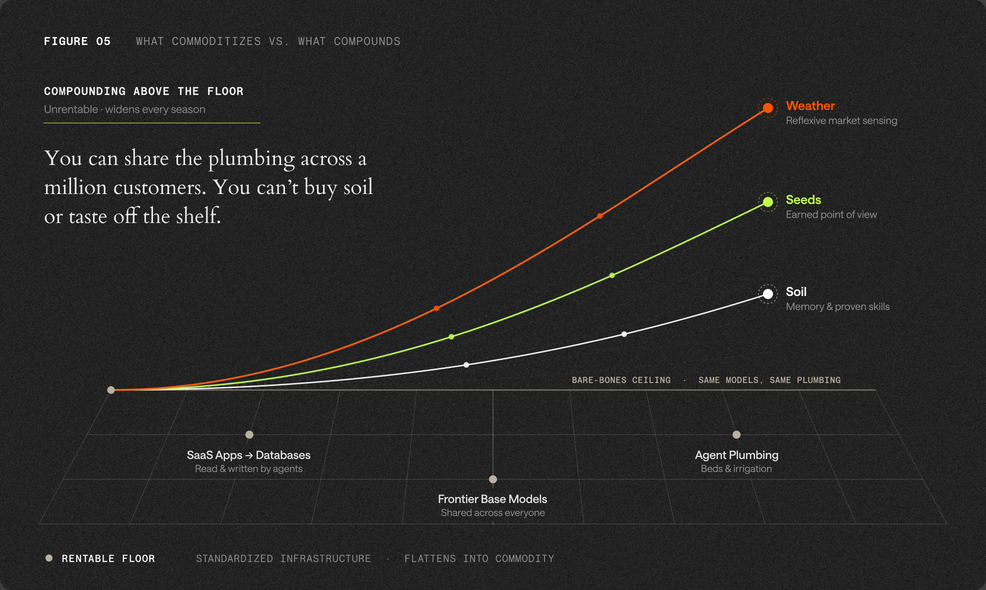
That leaves an awkward question for each company building on top. If the plumbing is standard and competitors call the same handful of models, where does lasting advantage live?
A great version of John’s platform is coming, from his team or a rival. Once the platform ships, your competitors can rent the same one.
What you can’t rent accumulates only through live briefs and launches: a memory of failed tests and why they failed, a point of view built from thousands of keep-or-kill calls, and listeners who know when they’re reading the swarm’s own wake.
Scoped memory, learned priors, and reflexive sensing won’t collapse into a database, because those layers only work inside the business that grew them. You can share the beds and the irrigation across a million customers. The gardens that last are the ones whose soil gets richer season after season.
More on Weather and Soil: Demand is a complex system and Commercial intelligence with infinite memory.
Figure 05 · What commoditizes vs. what compoundsSaaS, base models, and agent plumbing flatten into rentable commodities; scoped memory, earned taste, and reflexive sensing compound season over season.